The world of kitchen appliances is vast, and few tools offer the versatility and convenience of a good blender. From crafting silky-smooth morning smoothies to whipping up hearty soups and homemade nut butters, a blender can transform your culinary routine. As you explore the options, one specification consistently stands out: wattage. Manufacturers often tout high wattage numbers, leading many to wonder if more power equates to a universally superior blending experience. Specifically, is a 1500-watt blender truly essential for your kitchen, or could a lower-wattage model suffice? This comprehensive guide will demystify blender wattage, clarify its importance, and help you determine if a high-powered machine aligns with your specific blending needs.
A Comprehensive Guide to Blender Wattage
Understanding Blender Wattage: More Than Just a Number
Table is empty.At its core, blender wattage measures the electrical power the appliance consumes during operation. Think of it as the motor’s appetite for electricity. Generally, a higher wattage indicates a more potent motor, capable of spinning blades at greater speeds and generating more torque—the rotational force needed to process ingredients effectively. This raw power directly influences a blender’s ability to handle various tasks, from effortlessly pureeing soft fruits to tackling demanding ingredients like ice or fibrous vegetables. However, it’s crucial to understand that wattage often represents the input power, or how much electricity the motor draws, rather than the output power, which is the actual force applied to your ingredients. While a direct correlation often exists, the overall motor design, blade quality, and jar shape also play significant roles in converting that input wattage into tangible blending performance.
Common Blender Wattage Ranges and Their Applications
Blenders come in a wide array of wattages, each suited for different culinary demands. Understanding these ranges helps in aligning your purchase with your typical kitchen tasks:
- Low Wattage (300-600W): These blenders are ideal for basic, everyday tasks involving softer ingredients. Think simple fruit smoothies, protein shakes with powdered ingredients, pureeing cooked vegetables for baby food or smooth soups, and mixing batters. They are perfect for occasional use and lighter blending jobs where resistance is minimal.
- Mid-Range Wattage (600-1000W): Stepping up in power, mid-range blenders offer more versatility. They can handle regular daily smoothies, including those with some frozen fruit, light ice crushing for beverages, and preparing creamy dressings or sauces. This category often represents a good balance of power and affordability for most households.
- High Wattage (1000-1500W+): This is where blenders become true workhorses. High-wattage models are designed for heavy-duty tasks that challenge weaker motors. They excel at consistently crushing ice into snow, pulverizing frozen fruits and vegetables for thick smoothie bowls, grinding nuts into smooth butters, processing fibrous greens without leaving chunks, and even milling grains. These blenders are also more suitable for prolonged blending cycles and commercial environments, offering superior efficiency and durability against overheating.
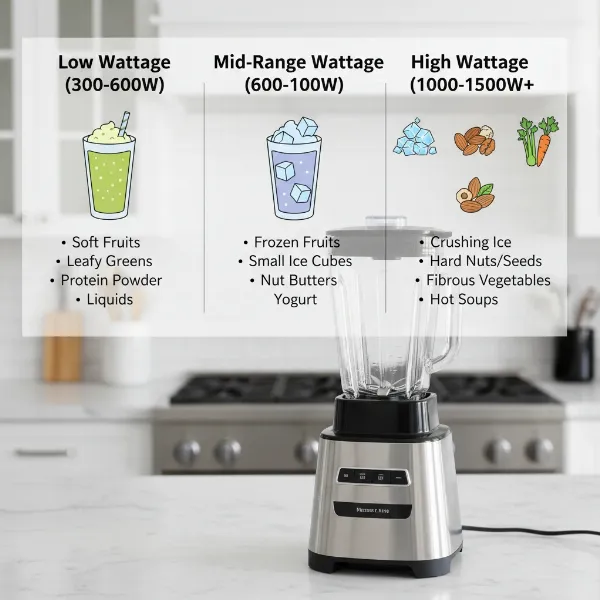 A chart illustrating different blender wattage ranges and their suitable blending tasks with icons for smoothies, ice crushing, and nut butter, in a modern kitchen setting.
Do You Really Need a 1500-Watt Blender?
The allure of a 1500-watt blender is strong, promising unmatched power and performance. For certain users and tasks, this high wattage is indeed a game-changer. If your culinary adventures frequently involve creating super-smooth green smoothies with tough kale or spinach, consistently crushing large quantities of ice, making velvety nut butters from scratch, or processing very dense ingredients, a 1500-watt model will deliver exceptional results. Its ability to maintain high blade speeds under heavy load means finer textures, faster processing times, and less strain on the motor, contributing to longer appliance life.
However, a 1500-watt blender isn’t a universal necessity. For individuals primarily blending soft fruits, cooked vegetables, or occasional light smoothies, such high power might be overkill. It often comes with a higher price tag, can be significantly noisier, and consumes more energy than its lower-wattage counterparts. While a 1500W model provides robust capability, many users find that a blender in the 800-1200W range offers a “sweet spot”—providing ample power for most demanding tasks without the added expense, noise, or potential for over-engineering for their specific needs.
> “While raw wattage is a key indicator of a blender’s potential, true performance emerges from the synergy of motor quality, blade design, and jar geometry. Don’t let a number alone define your blending experience.” – Admin, reviewsjt.com, Blender Technology Specialist
Beyond Wattage: Other Crucial Factors for Blender Performance
While wattage is a significant factor, it’s far from the only determinant of a blender’s overall performance and longevity. Savvy buyers understand that a holistic view is essential:
- Blade Design and Material: High-quality, durable stainless steel blades with a strategic configuration are paramount. Sharpness, number of blades, and their angle significantly impact how efficiently ingredients are cut and pulverized, regardless of motor power. Blenders designed for ice crushing, for instance, often feature robust, specialized blade assemblies.
- Container Shape and Material: The design of the blending jar plays a critical role in creating a proper vortex, which continuously draws ingredients down into the blades. Optimal container shapes prevent cavitation (air pockets) and ensure even blending. Materials like high-quality BPA-free plastic, glass, or stainless steel offer different levels of durability and aesthetic appeal.
- Motor Quality and Build: Beyond mere wattage, the engineering of the motor itself matters. Features like robust bearings, efficient cooling systems, and overload protection contribute to motor longevity and consistent performance, especially under heavy loads. A motor with good torque can power through tough ingredients without bogging down.
- Speed Settings and Pulse Function: A range of variable speeds allows for precise control over texture, from coarse chopping to ultra-fine pureeing. The pulse function is indispensable for quick bursts of power, ideal for achieving desired consistency or breaking down larger chunks before continuous blending.
- Overall Build Quality and Brand Reputation: A well-built blender, even one with slightly lower wattage, can outperform a higher-wattage model if its components are superior. Reputable brands often invest in research and development to create harmonious systems where wattage, blades, and jar work together efficiently.
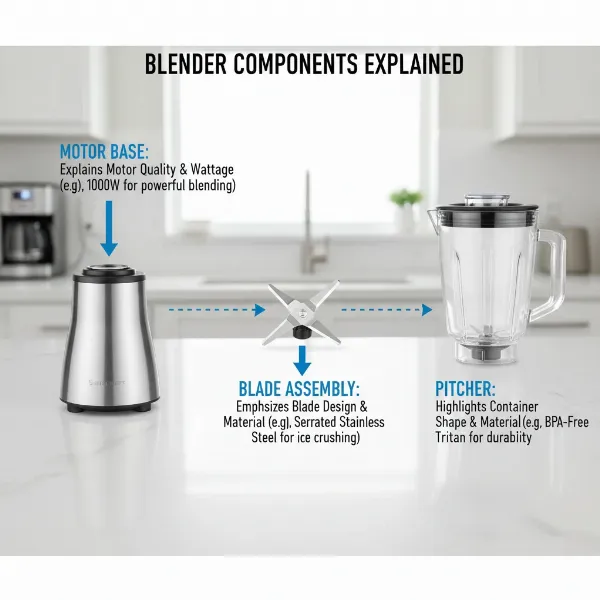 An exploded view of a blender highlighting key components like motor, blades, and jar, with labels indicating their contribution to performance.
Maximizing Your Blender’s Performance and Longevity
Regardless of your blender’s wattage, proper usage and maintenance can significantly enhance its performance and extend its lifespan.
- Proper Loading Techniques: Always add liquids first, followed by soft ingredients, then harder items (like ice or frozen fruit), and finally, smaller, denser ingredients (nuts, seeds). This layering helps the blades create a vortex more easily.
- Using Liquids Wisely: Adequate liquid is crucial for most blending tasks, especially with high-wattage blenders. Too little liquid can strain the motor and prevent ingredients from circulating properly.
- Don’t Overfill: Respect the maximum fill line on your blender jar to avoid spills and ensure efficient blending.
- Start Slow, Then Increase Speed: Begin blending at a low speed to incorporate ingredients, then gradually increase to higher speeds as needed. Use the pulse function for short bursts or to break down stubborn chunks.
- Clean Immediately: Rinse your blender jar and blades immediately after use to prevent food from drying and sticking. For deeper cleaning, blend warm water with a drop of dish soap.
- Inspect Blades Regularly: Check blades for any signs of dullness, damage, or wear. While blades are designed to be durable, continuous processing of hard ingredients can take a toll over time.
- Avoid Overheating: If your blender feels hot or emits a burning smell, turn it off and let it cool down before continuing. High-quality blenders have overheat protection, but prolonged stress can still cause issues.
Selecting the Perfect Blender for Your Culinary Journey
Choosing a blender isn’t about chasing the highest wattage number, but rather about selecting the right tool for your specific culinary journey. A 1500-watt blender is undoubtedly a powerhouse, offering unparalleled performance for the most demanding tasks like pulverizing ice, crafting smooth nut butters, and blending fibrous greens to perfection. However, for many home cooks, a mid-range blender (600-1200 watts) provides ample power and versatility for everyday needs, often at a more accessible price point.
Ultimately, the best blender for you will match your usage frequency, the types of ingredients you typically process, your budget, and your kitchen’s space. Consider the complete package: the synergy between the motor’s true power, the sharpness and design of the blades, the efficiency of the jar’s shape, and the overall build quality. Reading reviews and understanding how different models perform in real-world scenarios will be more insightful than focusing solely on a wattage figure. Make an informed choice, and your blender will be a reliable partner in countless delicious creations.
Frequently Asked Questions
What is a good wattage for a blender?
A good wattage for a blender typically falls between 500 to 1000 watts for general household use. This range provides enough power for most tasks, including making smoothies with frozen fruit, pureeing soups, and light ice crushing. For more demanding tasks like nut butter or heavy ice crushing, 1000-1500+ watts is considered ideal.
Does higher wattage mean better blending?
While higher wattage generally indicates a more powerful motor capable of handling tougher ingredients and producing finer textures, it’s not the sole determinant of blending quality. Blade design, jar shape, and overall motor quality are equally important. A well-engineered 800-watt blender might outperform a poorly designed 1200-watt model.
What can a 1500-watt blender do?
A 1500-watt blender is a high-performance machine capable of tackling virtually any blending task with ease. It excels at crushing large amounts of ice, making silky-smooth nut butters and flours, blending fibrous vegetables and frozen fruits into perfect consistency, and preparing hot soups through friction blending. These blenders are designed for efficiency and durability under heavy loads.
Is 600W enough for smoothies?
A 600-watt blender is generally sufficient for making most smoothies, especially if you primarily use soft fruits and liquids, and some frozen fruit. However, for very thick smoothies with lots of ice, fibrous greens like kale, or hard frozen ingredients, you might find a 600W blender struggles to achieve a perfectly smooth consistency, potentially leaving small chunks.