Dreaming of a luscious, velvety Hollandaise sauce to elevate your brunch or dinner, but intimidated by the traditional whisking and double-boiler dance? You’re not alone. Many home cooks shy away from this classic French sauce, fearing a split emulsion or a culinary disaster. But what if we told you that perfection is just minutes away, thanks to a simple kitchen appliance? Your blender is about to become your secret weapon for crafting a flawless Hollandaise that’s rich, tangy, and incredibly easy to achieve.
This guide will demystify the process, walking you through every step to create a restaurant-quality Hollandaise sauce with minimal effort. We’ll cover the essential ingredients, a foolproof step-by-step method, and expert tips to ensure your sauce is consistently creamy and delicious. Get ready to impress your family and friends with a sauce that tastes like you spent hours on it, all while enjoying the convenience of your trusty blender.
The Art of Effortless Hollandaise: Why Your Blender is the Secret Weapon
Hollandaise sauce is a true culinary marvel, transforming ordinary dishes into extraordinary experiences with its rich, buttery embrace. Traditionally, achieving its characteristic creamy texture required careful temperature control and continuous whisking over a double boiler—a technique that can be daunting for even seasoned chefs. The risk of the sauce “breaking” or separating was always high, leading to frustration and wasted ingredients.
This is where the humble blender steps in, revolutionizing the way home cooks approach this classic. By providing constant, high-speed agitation, the blender effortlessly emulsifies the egg yolks and hot butter, creating a stable, luscious sauce in a fraction of the time, and with significantly less stress. It takes the guesswork out of the equation, making Hollandaise accessible to everyone, regardless of their culinary experience.
Understanding Hollandaise: A Culinary Classic Made Easy
|
Our Picks for the Best Blender in 2026
As an Amazon Associate I earn from qualifying purchases.
|
||
| Num | Product | Action |
|---|---|---|
| 1 | BLACK+DECKER Crush Master Blender, 10-Speeds with Stainless Steel Blades, Black, BL2010BP |

|
| 2 | Ninja Professional Blender, Smoothie Blender, Drink Mixer, Grinder, Ice Crusher, Frozen Fruit Blending | Professional 1000 W Power, Total Crushing ™ Technology, XL 72-oz. Pitcher Black, Grey, BL610 |
|
| 3 | Ninja Professional Plus Blender | Max Power Smoothie Blender, Ice Cream Maker, Frozen Drink Mixer & Margarita Machine | 3 Auto IQ™ Presets, 1400 W, 72oz Total Crushing Pitcher | Dark Grey, BN701 |
|
| 4 | bella 10 Speed Countertop Blender, Juicer & Smoothie Maker, Fits-anywhere™ Kitchenware, Slim Flip & Store Design, Dishwasher Safe 48oz Capacity Pitcher & Lid, Stainless Steel Blade, 450 Watt, Oatmilk |
|
| 5 | Aeitto Blenders for Kitchen with 1800W Motor, 68Oz. Large Capacity, 2-in-1 Blender & Grinder Combo, BPA-Free Countertop Professional Blender for Smoothies, Ice Crush, Frozen Drinks, Black |
|
| 6 | nutribullet Full-Size Blender Combo 1200W – NBF50500 - Dark Gray |
|
| 7 | Ninja UltraCrush Professional Blender | 1000W, XL 72-oz.* Pitcher | Total Crushing Technology | 3 Manual Speeds for Ice Crushing, Smoothies, Sauces & More | Full-Size Blender | Black | BP201 |
|
| 8 | Hamilton Beach Power Elite Wave Action Blender For Smoothies, 40 Oz Glass Jar, 12 Functions Including Puree, Crush Ice, 700 Watts - Black (58148A) |
|
| 9 | BLACK+DECKER PowerCrush Multi-Function Blender with 6-Cup Glass Jar, 4 Speed Settings, Silver |
|
| 10 | Magic Bullet Blender, Small, Silver, 11 Piece Set |
|
At its heart, Hollandaise is an emulsion, a delicate suspension of liquid fat (butter) within another liquid (egg yolks and lemon juice). The egg yolks act as emulsifiers, binding the fat and water together to create a smooth, homogenous sauce. The traditional method relies on the chef’s skill and precision to slowly incorporate the hot butter while constantly whisking, gradually building the emulsion. Any sudden change in temperature or too rapid an addition of butter can cause the sauce to separate into an oily, curdled mess.
The blender method, however, bypasses these challenges. The powerful blades rapidly incorporate the ingredients, creating enough shear force to form a stable emulsion quickly. This means you can achieve that desired creamy consistency without the arm ache or the anxiety, making it the perfect technique for quick breakfasts, elegant brunches, or spontaneous gourmet meals.
Essential Ingredients for Your Blender Hollandaise
Creating a magnificent blender Hollandaise begins with selecting the right ingredients. While the technique simplifies the process, the quality of your components will significantly impact the final flavor and texture.
Here’s what you’ll need:
- Egg Yolks: Typically, three large egg yolks are ideal for a standard batch. Using room-temperature egg yolks is recommended, as they emulsify more easily than cold ones. If you’re concerned about consuming raw eggs, opt for pasteurized eggs.
- Unsalted Butter: One stick (8 tablespoons or 1/2 cup) of unsalted butter is usually sufficient. Melting the butter until it’s very hot and foamy is crucial for emulsification. Some recipes suggest clarified butter, but for the blender method, simply melted and hot butter works perfectly.
- Fresh Lemon Juice: One to two tablespoons of fresh lemon juice provide the essential tangy brightness that balances the richness of the butter and eggs. Always use fresh-squeezed juice for the best flavor.
- Salt: A pinch of salt enhances all the flavors in the sauce. Taste and adjust as needed.
- Cayenne Pepper (Optional): A tiny pinch of cayenne pepper adds a subtle warmth and depth without making the sauce spicy. It’s a classic addition that brings a hint of sophistication.
- Hot Water (Optional): If your sauce turns out too thick, a tablespoon or two of hot water can help achieve the desired flowing consistency.
The beauty of this recipe lies in its simplicity. High-quality ingredients, combined with the blender’s efficiency, yield an impressive result every time.
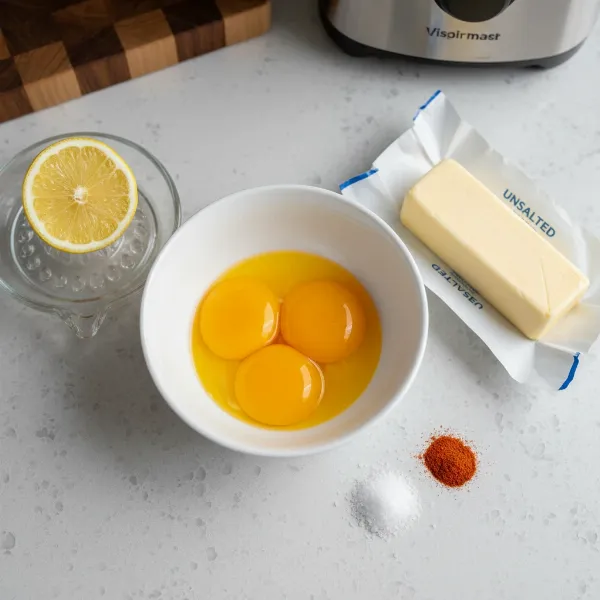 Fresh ingredients for blender hollandaise sauce: egg yolks, lemon, butter, salt, and cayenne pepper laid out on a kitchen counter.
Step-by-Step: Crafting Your Blender Hollandaise in Minutes
Making Hollandaise in a blender is surprisingly straightforward. Follow these steps for a perfect, velvety sauce:
- Prepare Your Butter: In a small saucepan, melt your butter over medium heat until it’s very hot and foamy. You want it sizzling, but be careful not to let it brown or burn. This intense heat is vital for both cooking the egg yolks and creating a stable emulsion. Keep the butter hot until you’re ready to use it.
- Combine Base Ingredients: Crack your room-temperature egg yolks into the blender jar. Add the fresh lemon juice, a pinch of salt, and the optional cayenne pepper.
- Initial Blend: Secure the blender lid, ensuring the center cap (feeder cap) is removable. Blend the egg yolk mixture on a medium to medium-high speed for about 20-30 seconds, or until the mixture becomes lighter in color and slightly frothy. This pre-blending helps to aerate the yolks and prepare them for emulsification.
- The Crucial Butter Drizzle: With the blender still running on medium speed, slowly and steadily begin pouring the very hot melted butter through the opening in the blender lid. The key here is a thin, continuous stream. The high-speed blades will incorporate the hot fat into the egg mixture, thickening it into a rich, creamy sauce. This process should take about 30-60 seconds.
- Final Blend and Seasoning: Once all the butter is incorporated, continue blending for another 10-15 seconds until the sauce is thick, smooth, and cohesive. Taste the Hollandaise and adjust the seasoning as needed, adding more salt, lemon juice, or a touch more cayenne to suit your preference. If the sauce is too thick for your liking, you can add a tablespoon of hot water at a time while pulsing the blender until it reaches the desired consistency.
- Serve Immediately: Hollandaise sauce is best served fresh. Its delicate emulsion is prone to separating if it cools down too much or is reheated improperly. Spoon it generously over your favorite dishes and enjoy!
Troubleshooting Common Blender Hollandaise Issues
Even with the blender method, a few common issues can arise. Knowing how to troubleshoot them will ensure your Hollandaise is always a success.
Too Thick or Too Thin? Achieving the Perfect Consistency
The ideal Hollandaise sauce should be thick enough to coat the back of a spoon, yet still pourable.
- If your sauce is too thick: This often happens if the butter was added too quickly or if the eggs were very large. To thin it out, simply add a tablespoon of hot water, a few drops at a time, while pulsing the blender until you reach your desired consistency. The hot water helps loosen the emulsion without breaking it.
- If your sauce is too thin: This can occur if the butter wasn’t hot enough, if too much liquid (lemon juice or water) was added, or if the blender wasn’t running at a high enough speed during emulsification. While it’s harder to fix a truly thin sauce, you can try adding another egg yolk (at room temperature) and slowly blending it in. Ensure your butter is piping hot the next time.
Preventing a Broken Sauce: Tips for a Smooth Emulsion
A “broken” Hollandaise sauce appears oily and curdled, with the fat separating from the egg mixture. This is usually due to temperature issues or adding the butter too quickly.
- Ensure Butter is Very Hot: The heat from the butter cooks the egg yolks slightly, which is essential for forming a stable emulsion. If the butter is merely warm, the sauce is more likely to break.
- Slow and Steady Pour: This is perhaps the most critical step. Drizzling the hot butter in a slow, thin stream allows the egg yolks to gradually incorporate the fat, building a strong emulsion. Pouring too quickly can overwhelm the egg yolks, causing them to separate.
- Keep the Blender Running: Continuous blending ensures constant agitation, which is necessary for the emulsion to form and stay stable. Don’t turn off the blender until all the butter is incorporated.
- Use Room Temperature Eggs: Cold eggs can cool down the hot butter too rapidly, making emulsification difficult. Let your egg yolks sit out for 15-20 minutes before starting.
Flavor Adjustments: Balancing Tang and Richness
Hollandaise is known for its delicate balance of rich butter and bright lemon. Achieving your preferred flavor profile is easy:
- More Tang: If you desire a more pronounced lemony zest, add an additional teaspoon of fresh lemon juice at the end, blending it in briefly.
- Enhanced Savory Notes: A tiny dash more of salt can amplify the overall flavor. For a subtle kick, another pinch of cayenne pepper can be added.
- Richness: The richness comes primarily from the butter. While you can’t add more butter once the sauce is made, ensuring you use high-quality butter will yield the best flavor.
Elevate Your Meals: Dishes Perfect with Blender Hollandaise
Once you’ve mastered the art of blender Hollandaise, a world of culinary possibilities opens up. This versatile sauce pairs beautifully with a myriad of dishes, transforming everyday meals into gourmet delights.
The most iconic pairing is, of course, Eggs Benedict. The creamy Hollandaise cascades over perfectly poached eggs, Canadian bacon, and toasted English muffins, creating a symphony of textures and flavors. Beyond this brunch classic, Hollandaise is also sublime with:
- Asparagus: Steamed or roasted asparagus spears become an elegant side dish when drizzled with Hollandaise.
- Other Vegetables: Broccoli, green beans, artichokes, and even roasted potatoes are wonderfully complemented by its rich flavor.
- Fish: A dollop of Hollandaise sauce over pan-seared salmon, baked cod, or halibut adds a luxurious touch and moistness.
- Steak: For an indulgent twist, try serving Hollandaise alongside a perfectly cooked steak. It offers a decadent alternative to traditional béarnaise.
- Chicken and Pork: A lighter drizzle can enhance grilled chicken breasts or tender pork medallions.
Hollandaise sauce truly makes any dish feel special, adding a touch of French sophistication with minimal effort.
Beyond the Basics: Storing and Reheating Hollandaise
The delicate nature of Hollandaise means it’s best enjoyed immediately after preparation. Its emulsion is sensitive to temperature changes and tends to break down when cooled or reheated.
- Immediate Consumption is Key: For the best texture and flavor, plan to make your Hollandaise sauce just before serving. It’s so quick to prepare with a blender that timing it with the rest of your meal is quite manageable.
- Keeping Warm Briefly: If you need to keep it warm for a short period (up to 30 minutes), transfer the blender jar or the sauce itself to a heat-safe bowl set over a larger bowl of very warm (not hot or boiling) water. Stir gently every few minutes. Avoid direct heat, which will cause the eggs to scramble and the sauce to separate.
- Challenges of Reheating: Reheating Hollandaise sauce is generally not recommended, as it almost invariably leads to a broken or curdled sauce. The emulsion is simply too fragile to withstand significant temperature fluctuations. If you find yourself with leftover sauce, it’s usually best to discard it, as its texture and safety can be compromised. For future meals, simply whip up a fresh batch in minutes using your blender.
Conclusion
Mastering Hollandaise sauce, once considered a chef’s ultimate test, is now effortlessly within reach for every home cook, thanks to the magic of the blender. This modern technique simplifies the process, eliminating the intimidation of whisking over a double boiler and minimizing the risk of a broken sauce. By understanding a few key principles—using hot butter, fresh ingredients, and a slow, steady drizzle—you can consistently create a rich, creamy, and tangy Hollandaise that rivals any restaurant’s offering.
Embrace the convenience and reliability of your blender to elevate your culinary creations, from classic Eggs Benedict to elegant asparagus and delicate fish dishes. There’s no longer any reason to shy away from this luxurious sauce. What delicious dish will you crown with your homemade blender Hollandaise first?
Frequently Asked Questions
Can you use a food processor for Hollandaise?
While a high-powered blender is ideal due to its blade speed and design for continuous pouring, some food processors can work. However, the results might be less consistent than with a blender, and some food processors may struggle to achieve the same fine emulsion.
What kind of butter should I use?
Unsalted butter is generally recommended as it allows you to control the saltiness of the final sauce. However, if salted butter is all you have, you can use it and simply adjust the added salt accordingly. The most critical factor is ensuring the butter is very hot and foamy when incorporated.
Why is my Hollandaise sauce too thin/broken?
A thin or broken sauce is often caused by butter that wasn’t hot enough, adding the butter too quickly, or the blender not running at a consistent, high speed. The hot butter helps cook the eggs and creates the emulsion; if it’s not hot enough, the emulsion won’t form properly.
How long does blender Hollandaise last?
Hollandaise sauce is highly perishable and best consumed immediately. It does not store or reheat well. For food safety and quality, it should ideally be used within an hour or kept warm (not hot) for a very short period.
Can I make Hollandaise without lemon juice?
Lemon juice is a fundamental ingredient in Hollandaise, providing essential acidity and flavor balance. While you technically could omit it, the sauce would lack its characteristic tang and brightness, tasting overly rich and one-dimensional. Some recipes might substitute white wine vinegar, but lemon juice is the classic choice.