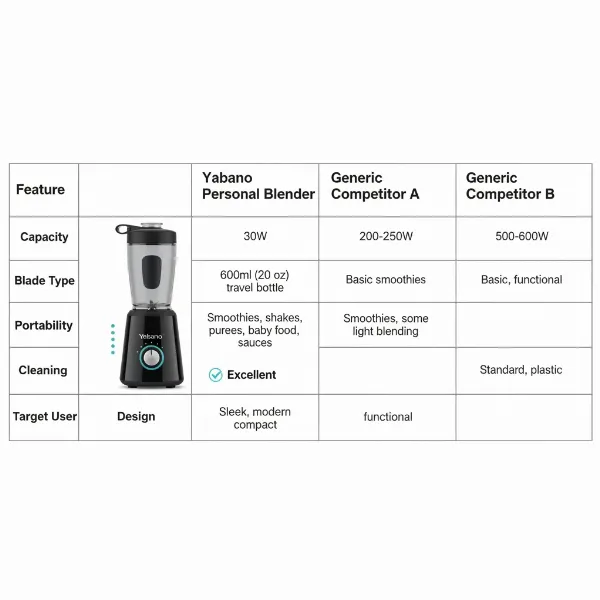
Are you standing in the blender aisle, feeling overwhelmed by the sheer number of options? Whether you’re a smoothie enthusiast, a culinary adventurer, or someone simply looking for a quick and healthy meal, selecting the right blender can feel like a daunting task. The choice often boils down to two main contenders: the robust countertop blender and the convenient personal blender. Each offers distinct advantages tailored to different lifestyles and kitchen needs. Understanding their core differences and unique capabilities is key to finding the appliance that seamlessly integrates into your daily routine and helps you achieve your blending goals with ease.
Detailed Guide to Buying Your Blender
Choosing between a countertop and a personal blender means evaluating your habits, space, and specific culinary aspirations. Let’s delve into the characteristics of each type and the factors that should influence your decision.
Popular Blender Types on the Market
|
Our Picks for the Best Blender in 2026
As an Amazon Associate I earn from qualifying purchases.
|
||
| Num | Product | Action |
|---|---|---|
| 1 | BLACK+DECKER PowerCrush Multi-Function Blender with 6-Cup Glass Jar, 4 Speed Settings, Silver |

|
| 2 | Ninja Professional Plus Blender | Max Power Smoothie Blender, Ice Cream Maker, Frozen Drink Mixer & Margarita Machine | 3 Auto IQ™ Presets, 1400 W, 72oz Total Crushing Pitcher | Dark Grey, BN701 |
|
| 3 | Ninja UltraCrush Professional Blender | 1000W, XL 72-oz.* Pitcher | Total Crushing Technology | 3 Manual Speeds for Ice Crushing, Smoothies, Sauces & More | Full-Size Blender | Black | BP201 |
|
| 4 | Aeitto Blenders for Kitchen with 1800W Motor, 68Oz. Large Capacity, 2-in-1 Blender & Grinder Combo, BPA-Free Countertop Professional Blender for Smoothies, Ice Crush, Frozen Drinks, Black |
|
| 5 | BLACK+DECKER Crush Master Blender, 10-Speeds with Stainless Steel Blades, Black, BL2010BP |
|
| 6 | Magic Bullet Blender, Small, Silver, 11 Piece Set |
|
| 7 | nutribullet Full-Size Blender Combo 1200W – NBF50500 - Dark Gray |
|
| 8 | Ninja Professional Blender, Smoothie Blender, Drink Mixer, Grinder, Ice Crusher, Frozen Fruit Blending | Professional 1000 W Power, Total Crushing ™ Technology, XL 72-oz. Pitcher Black, Grey, BL610 |
|
| 9 | bella 10 Speed Countertop Blender, Juicer & Smoothie Maker, Fits-anywhere™ Kitchenware, Slim Flip & Store Design, Dishwasher Safe 48oz Capacity Pitcher & Lid, Stainless Steel Blade, 450 Watt, Oatmilk |
|
| 10 | Hamilton Beach Power Elite Wave Action Blender For Smoothies, 40 Oz Glass Jar, 12 Functions Including Puree, Crush Ice, 700 Watts - Black (58148A) |
|
The blender landscape is primarily dominated by two categories: powerful countertop models and compact personal blenders. Each serves a unique purpose in the modern kitchen.
Countertop Blenders
Countertop blenders, often referred to as full-size or jug blenders, are the workhorses of the kitchen. They are designed for durability and high performance, making them indispensable for a wide range of tasks.
- Pros: Countertop blenders boast impressive power, typically ranging from 500 to 1,800 watts, with some professional-grade models reaching up to 2.2 horsepower. This significant power allows them to effortlessly crush ice, blend frozen fruits, and tackle fibrous vegetables for silky-smooth results. Their large capacity, usually between 48 and 72 ounces, makes them ideal for preparing family-sized meals, batch cooking, or entertaining guests. Many also feature multiple speed settings and preset programs, offering precise control over texture and consistency, and some can even safely blend hot liquids for soups.
- Cons: These blenders are generally larger and heavier, requiring dedicated counter space and making them less portable. Their powerful motors can also be quite noisy, which might be a consideration for early morning use or shared living spaces. While many have self-cleaning functions, their larger components can sometimes require more effort to clean compared to their smaller counterparts.
- Ideal Users: Countertop blenders are perfect for families, avid meal preppers, those who frequently entertain, and serious home cooks who demand versatility and power for complex recipes like nut butters, hot soups, and large batches of sauces.
Personal Blenders
Personal blenders, also known as mini or portable blenders, prioritize convenience and mobility. They are designed for quick, individual servings and on-the-go lifestyles.
- Pros: These blenders are compact and lightweight, often weighing just 1–2 pounds, and typically offer jar capacities from 12 to 32 ounces, perfectly suited for single or double servings. Many models are cordless, operating on rechargeable batteries that provide 15 to 30 blend cycles per charge, freeing you from power outlets. Their “blend-and-sip” design means you can often drink directly from the blending cup, which usually comes with a travel lid, simplifying your routine and reducing cleanup. They are also generally quieter than countertop models.
- Cons: Personal blenders typically have lower wattage motors (70–300 watts, though some can reach 900 watts), meaning they might struggle with very tough ingredients like large ice cubes or hard nuts, often requiring ingredients to be cut into smaller pieces. Their smaller capacity limits them to single servings, making them unsuitable for large families or batch meal prep. Battery life, while convenient, means they need regular recharging.
- Ideal Users: Personal blenders are best for busy professionals, commuters, fitness enthusiasts, college students, or anyone with limited kitchen space who primarily needs quick, single-serve smoothies, protein shakes, or small sauces on the go.
Key Factors to Consider When Buying a Blender
When investing in a new blender, several critical factors should guide your decision to ensure it meets your specific needs.
- Power (Wattage/Horsepower): This is perhaps the most crucial factor, as it dictates what your blender can handle. Higher wattage (500-1800W for countertop, up to 900W for some personal) means more power to pulverize tough ingredients like ice, frozen fruits, and nuts into a smooth consistency. If you frequently make green smoothies with fibrous vegetables or nut butters, a high-powered countertop blender is essential. For simple protein shakes or soft fruit smoothies, a personal blender with adequate wattage (175-300W) should suffice. Using a lower-powered blender for heavy-duty tasks can lead to motor burnout.
- Capacity (Jar Size): Consider how many servings you typically blend at once. Personal blenders offer 12 to 32 ounces, ideal for one or two servings. Countertop blenders, with their 48 to 72-ounce pitchers, are built for larger quantities, perfect for families or meal prepping. Never fill a blender to the very top; leave some space for efficient blending.
- Material (Jar & Blades): Blender jars are typically made of durable plastic or glass. While glass offers a classic aesthetic and doesn’t retain odors, it is heavier and more prone to breaking if dropped. High-quality plastic jars (often BPA-free) are lighter and more durable against everyday bumps. For blades, look for stainless steel. Personal blenders often benefit from dull blades with at least four prongs for better consistency and durability, especially when blending frozen ingredients.
- Features and Settings: Beyond basic on/off, look for a pulse function to chop ingredients or handle thicker mixtures. Countertop blenders often come with multiple speed settings (e.g., 5-10 speeds) and preset programs for specific tasks like “smoothie,” “ice crush,” or “soup.” Some even include tampers to help push ingredients down. Personal blenders are usually simpler, with single-button operation, but newer models may include pulse or multiple speeds. Cordless options with USB charging enhance portability.
- Brand Reputation and Price: Reputable brands often offer better performance, durability, and customer support. Personal blenders range from $22.50 to $90, while countertop models start around $110 and can exceed $800 for high-end options like Vitamix. Your budget should align with your blending frequency and the complexity of tasks you intend to perform. An investment in a higher-priced, durable countertop blender can be worthwhile for frequent, heavy-duty use.
- Cleaning Ease: This can significantly impact your user experience. Many blenders feature dishwasher-safe parts or self-cleaning modes (blending water with a drop of soap). Personal blenders are generally easier to clean due to their smaller size and fewer components, often requiring just a quick rinse.
Blender for Your Budget
The price of a blender often reflects its power, features, and durability. Here’s a general breakdown by budget:
- Budget-Friendly (Under $100): This segment is dominated by personal blenders, offering excellent value for single-serve smoothies and basic blending tasks. You can find reliable mini blenders like the BLENDi Lite starting at $22.50. Some entry-level countertop blenders, such as the Oster 1500 Watt Extreme Mix Blender, can also be found in this range, providing decent power for everyday use.
- Mid-Range ($100 – $300): This price point offers a good balance of power and features, primarily for countertop blenders, but also includes some premium personal blenders. You’ll find models capable of handling frozen ingredients and more diverse recipes. Brands like KitchenAid (e.g., K400 Blender) and Breville (e.g., Fresh & Furious) offer strong performance and durability in this range.
- High-End (Above $300): This category features professional-grade countertop blenders from brands like Vitamix, known for their exceptional power (1,400-1,800+ watts), durability, and versatility. These blenders can tackle virtually any blending task, from ultra-smooth purees to hot soups, and are built to last for many years, justifying their higher investment.
Tips for Using and Maintaining Your Blender Correctly
Proper usage and care are crucial for maximizing your blender’s performance and extending its lifespan.
- Safe and Efficient Use:
- Layer Ingredients Properly: Always add liquids first, followed by soft ingredients (leafy greens, soft fruits), then harder items (frozen fruit, ice), and finally powders. This helps create a vortex for efficient blending.
- Don’t Overfill: Never fill the blender past its maximum capacity line to prevent spills and ensure proper blending.
- Cut Ingredients: Especially for personal blenders or less powerful models, cut tough fruits, vegetables, and ice into smaller pieces.
- Use Pulse Function: For chunky textures like salsa or to break down large pieces before continuous blending, use the pulse setting.
- Avoid Overheating: Many blenders, especially personal ones, have a recommended maximum continuous blending time (often 60 seconds) to prevent the motor from overheating.
- Cleaning and Maintenance:
- Immediate Rinse: The easiest way to clean any blender is to rinse the jar and blades immediately after use to prevent food from drying and sticking.
- Self-Cleaning: For many countertop blenders, fill the jar halfway with warm water, add a drop of dish soap, and blend on high for 30-60 seconds, then rinse thoroughly.
- Dishwasher Safe Parts: Check your manual to see which components (jar, lid, blades) are dishwasher safe.
- Hand Washing: For blades that aren’t detachable or dishwasher-safe, use a brush and be cautious of sharp edges. For removable bottom blenders, ensure the gasket is properly re-secured to prevent leaks.
- Base Care: Always unplug the unit before wiping down the motor base with a damp cloth; never submerge the electrical components in water.
- Common Issues and Troubleshooting:
- Motor Overheating: If your blender stops or smells like it’s burning, it might be overheating. Turn it off, unplug it, and let it cool down before trying again. Reduce ingredient load or add more liquid.
- Ingredients Stuck: If ingredients aren’t blending, add more liquid, use the pulse function, or use a tamper (if your model has one) to push food towards the blades. Avoid using utensils while the blender is running.
- Leaking: Ensure all parts, especially the blade assembly and gasket, are securely tightened before blending.
Detailed Comparison Table of Top Blenders
Here’s a comparison of exemplary models, illustrating the range of features across different blender types.
| Feature | Countertop Blender (Vitamix Propel Series 750) | Personal Blender (Nutribullet Pro 900) | Portable Blender (Ninja Blast Portable Blender) |
|---|---|---|---|
| Power | 2.2 horsepower (approx. 1640 watts) | 900 watts | Not specified, but designed for portability (effective for its size) |
| Capacity | 64 ounces | Two 32-ounce cups | 18 ounces |
| Primary Use | Smoothies, frozen desserts, soups, dips & spreads, nut butters, large batches | Single-serve drinks, smoothies, dips | Smoothies, protein shakes on-the-go |
| Portability | Low (heavy, stationary) | Low (stationary base, but blend-and-go cups) | High (lightweight, rechargeable battery, fits cup holders) |
| Settings | 10 variable speeds, 5 presets, pulse | 1 powerful speed | 1 speed, separate power/blend controls |
| Ice Crushing | Excellent | Easily blasts through ice | Needs multiple whirls, can be chunky |
| Cleaning | Self-cleaning cycle, dishwasher-safe components | Dishwasher-safe cups and lids | Easy and quick, good battery life and easy to recharge |
| Price | ~$448 | ~$50 | ~$45 |
| Pros | Incredible power, durability, versatility, fits under cabinets | Powerful and quick for single servings, easy to use/clean | Easy and quick blending, good battery life, fits cup holder |
| Cons | Bulky, higher price point | Only one speed, limited to 60-second blends | Short charging cord, needs more effort for fibrous greens |
Your Blender Buying Guide: Finding the Perfect Match
Choosing a blender is a personal journey, deeply intertwined with your lifestyle, dietary habits, and available kitchen real estate.
Important Criteria for Blender Selection
- Determine Your Primary Use: Are you primarily making daily single-serve smoothies for your commute, or do you need to blend large batches of soup, crush ice for cocktails, or make nut butters for the family? This will instantly narrow down your choices.
- Assess Your Space and Storage: If counter space is precious or you live in a dorm, a compact personal blender is a practical choice. If you have ample kitchen space and plan to use it frequently, a countertop blender can be a permanent fixture.
- Consider Ingredient Types: The tougher the ingredients (e.g., whole nuts, ice, frozen root vegetables), the more powerful a motor you’ll need. High-wattage countertop blenders are engineered for these demanding tasks, while most personal blenders are better suited for softer fruits and protein powders.
- Evaluate Portability Needs: Do you need to blend at the gym, office, or while traveling? A cordless, lightweight personal blender is designed for exactly this. For home-centric blending, portability is less of a concern.
- Set a Realistic Budget: While high-end blenders offer unmatched performance and durability, excellent mid-range and budget-friendly options exist for specific needs. Prioritize features that are most important to you within your price range.
Analyzing Pros and Cons of Different Blender Types
The decision between a countertop and a personal blender is a trade-off between power/capacity and convenience/portability.
- Countertop Blenders (Pros): Superior power for tough ingredients, larger capacity for families/batch cooking, more versatile with multiple speeds/presets, can handle hot liquids.
- Countertop Blenders (Cons): Bulky, less portable, generally louder, higher price point.
- Personal Blenders (Pros): Compact, highly portable (cordless options), easy for single-servings, simpler cleanup, more affordable.
- Personal Blenders (Cons): Lower power, limited capacity, may struggle with tough ingredients, battery life can be a concern for cordless models.
Choosing a Blender to Match Your Needs and Budget
Ultimately, the best blender is the one that aligns perfectly with your individual circumstances.
If you are:
- A busy individual needing quick, healthy drinks on the go, often traveling or commuting, and have limited kitchen space, a personal blender is likely your ideal choice.
- A family or an avid home cook who regularly prepares large meals, experiments with diverse recipes (soups, nut butters, frozen desserts), and requires robust power for tough ingredients, a countertop blender will be an invaluable asset.
Consider a dual-blender approach if your needs span both ends of the spectrum: a powerful countertop model for home cooking and a compact personal blender for your active lifestyle. This ensures you’re equipped for every blending occasion.
“A countertop blender delivers the silkiest smoothies, daiquiris, soups, and sauces of any type of blender you can buy. It’s more versatile than a personal blender (which is intended primarily for making smoothies) because it holds more and can handle hot liquids.” – Wirecutter
Conclusion
The journey to finding the perfect blender, whether a countertop powerhouse or a personal convenience king, hinges on understanding your lifestyle and culinary demands. Countertop blenders shine with their superior power and large capacities, making them essential for families, meal preppers, and those who tackle challenging ingredients like ice and frozen fruits. They offer unmatched versatility for everything from creamy soups to homemade nut butters.
Conversely, personal blenders are champions of convenience and portability. They are the go-to for quick, single-serve smoothies and shakes, perfect for busy individuals, gym-goers, and anyone with limited kitchen space. While they may not match the raw power of their larger counterparts, their ease of use and on-the-go design are undeniable assets.
Ultimately, the best blender isn’t about having the most features, but rather about how well it fits into your daily routine and helps you achieve your health and culinary goals. By evaluating your blending frequency, typical ingredients, desired serving sizes, and available space, you can confidently choose the blender that truly enhances your kitchen experience.
What kind of blending adventures are you hoping to embark on?
Frequently Asked Questions
Which type of blender is better for crushing ice?
For consistently crushing ice and frozen ingredients, a countertop blender is generally superior due to its significantly more powerful motor (500–1,800 watts) and robust blade systems. While some high-wattage personal blenders can handle ice, countertop models are designed for this task with greater efficiency and consistency, creating smoother results for frozen drinks and smoothies.
Can personal blenders be used for hot liquids like soup?
Most personal blenders are not designed for hot liquids due to their smaller, sealed containers which can build up pressure. Countertop blenders are generally safer and more effective for blending hot liquids like soups, as many models have vented lids or pitchers made from materials like glass that can withstand higher temperatures. Always check the manufacturer’s instructions for your specific blender model.
How important is wattage in a blender?
Wattage is highly important as it directly correlates with a blender’s power and its ability to process various ingredients. Higher wattage motors (e.g., 1000W+) can effortlessly blend tough items like nuts, seeds, and frozen produce into smooth textures, preventing motor strain and ensuring durability. Lower wattage blenders (e.g., 70-300W) are best for softer ingredients and light blending tasks.
Are personal blenders difficult to clean?
No, personal blenders are generally very easy to clean. Their compact size and fewer detachable parts often allow for a quick rinse immediately after use. Many come with cups that can be rinsed and drunk from directly, and most components are dishwasher-safe, making cleanup quick and hassle-free, especially compared to larger, multi-component countertop blenders.